
Predictive maintenance has become a strategic priority for manufacturers, facilities managers, and asset-intensive organizations seeking to reduce downtime and improve operational performance. Advances in sensors, connectivity, analytics, and AI have made it possible to identify asset issues before failures occur. However, many predictive maintenance initiatives fail to deliver their expected value.
The reason is often not a lack of technology. Instead, the problem stems from siloed systems that prevent critical information from flowing from end-to-end.
Predictive maintenance relies on data to maintain accurate forecasts. This includes:
- Equipment condition data.
- Work order history.
- Inventory records.
- Asset performance metrics.
- Production schedules.
- Reliability trends.
When this information is trapped in disconnected systems, organizations struggle to generate reliable insights that support effective decision-making. It’s become clear predictive maintenance is not just a sensor project or an analytics initiative. It is a data integration challenge that requires a complete view of assets, operations, and maintenance activities.
Without that visibility, predictive maintenance programs often become reactive exercises disguised as proactive strategies.
Disconnected Data Creates Blind Spots Across Operations
Most organizations have made large investments in technology platforms such as:
- Enterprise resource planning (ERP) systems.
- Manufacturing execution system (MES) software.
- Building automation systems (BAS).
- Industrial control systems (ICS).
- Inventory applications.
- Monitoring tools.

On their own, each platform generates valuable information. The problem is these systems often operate independently from one another, preventing maintenance teams from getting a clearer picture of the situation.
As a result, maintenance teams may receive alerts indicating abnormal equipment conditions without access to the historical maintenance context that explains the issue. Reliability engineers may identify recurring failure patterns but lack visibility into spare parts availability or production schedules. Executives may review operational dashboards that show rising maintenance costs without understanding the underlying drivers affecting asset performance.
These gaps create blind spots that undermine predictive maintenance efforts.
For example, vibration monitoring may identify a bearing issue on a critical production asset. If maintenance records, inventory data, and operational schedules are maintained in separate systems, maintenance planners may struggle to determine the urgency of the repair. They might not know whether replacement components are available, or how the repair will affect production targets. The result is slower decision-making and increased operational risk.
Siloed systems also negatively affect data quality. Duplicate records, inconsistent asset naming conventions, and fragmented reporting structures make it difficult to generate trustworthy analytics. Predictive models are only as accurate as the data they consume. When information is incomplete or inconsistent, maintenance recommendations become less reliable.
This creates a significant challenge for organizations attempting to scale predictive maintenance programs across multiple facilities or asset classes.
Integrated Maintenance Platforms Strengthen Predictive Maintenance Results
Organizations that successfully implement predictive maintenance typically establish a connected digital ecosystem that centralizes asset information and operational data. A modern CMMS serves as a critical foundation for this strategy. By integrating maintenance activities with asset histories, condition monitoring tools, inventory systems, and operational data sources, organizations create a single source of truth for decision-makers.
This connected environment allows predictive insights to drive action rather than simply generate alerts.
When an asset exhibits signs of deterioration, maintenance teams can immediately access historical work orders, warranty information, replacement part availability, technician notes, and asset performance trends. Instead of responding to isolated data points, teams can make informed decisions based on complete operational context.
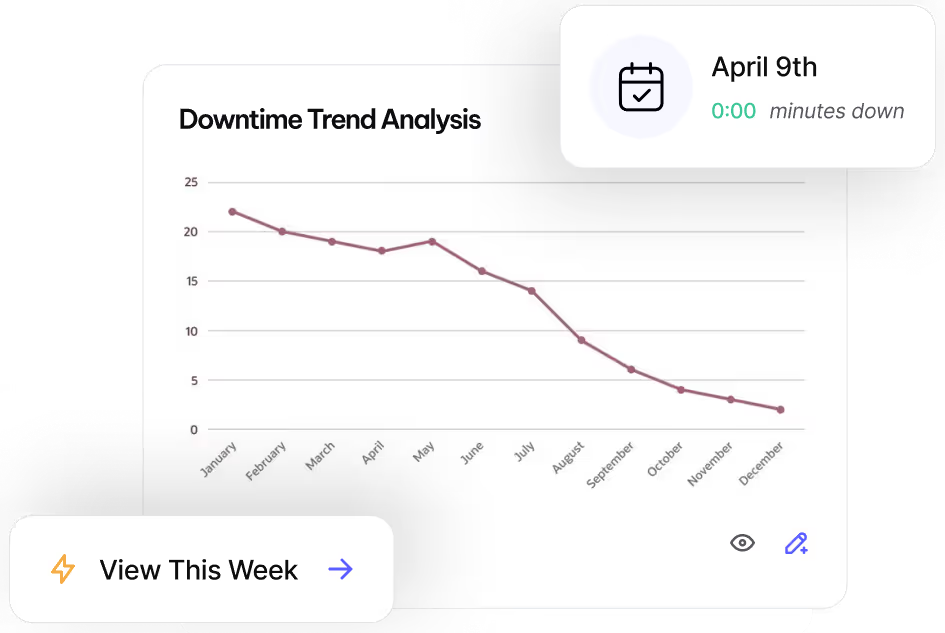
This capability delivers measurable business benefits. Downtime is reduced because maintenance activities can be planned before failures occur. Labor efficiency improves because technicians spend less time gathering information and more time executing work. Inventory costs become easier to manage because planners can better anticipate parts requirements. Asset lifespan may also increase because maintenance interventions occur at the appropriate time rather than too early or too late.
Technology leaders benefit, as well. Integrated systems provide stronger governance, improved reporting accuracy, and better support for digital transformation initiatives. Rather than managing multiple disconnected technologies, organizations can build scalable maintenance strategies that align with broader business objectives.
For reliability professionals, integrated data supports more sophisticated analysis of failure modes and performance trends. Patterns that may remain invisible within isolated datasets become easier to identify when information is aggregated and standardized.
Executives benefit because they can have confidence in the numbers. When all the different departments are connected, leadership teams can more accurately evaluate and assess the return on predictive maintenance initiatives.
The future of predictive maintenance depends on AI and advanced analytics. However, even the most advanced predictive technologies cannot overcome fragmented data environments. Organizations that continue operating with disconnected systems may find themselves collecting more data while generating fewer actionable insights.
Predictive maintenance succeeds when the right information reaches the right people at the right time. Achieving that outcome requires a connected operational framework that breaks down data silos and creates a complete picture of asset health. The takeaway is clear: Predictive maintenance is only as strong as the data ecosystem supporting it.
Organizations that prioritize integration are better positioned to improve reliability, reduce downtime, control costs, and transform maintenance from a reactive function into a strategic business advantage.
Learn how MVP One improves predictive maintenance.