
Preventive maintenance has long been recognized as one of the most effective strategies for improving asset reliability and reducing unplanned downtime. Yet many organizations struggle to scale their programs as facilities grow, equipment inventories expand, and maintenance demands become more complex. What works for a single site often breaks down when maintenance teams attempt to replicate processes across multiple locations.
A computerized maintenance management system (CMMS) provides the foundation required to build a preventive maintenance program that can grow with the organization. Rather than relying on spreadsheets, paper records, or disconnected systems, maintenance leaders can use CMMS technology to standardize processes, automate workflows, and create data-driven maintenance strategies that support long-term operational goals.
For maintenance professionals, reliability engineers, and executives, scalability is not simply about managing more assets. It is about maintaining consistency, visibility, and performance as operations expand.
Establishing Standardized Maintenance Processes
A scalable preventive maintenance program begins with standardization. Many organizations accumulate maintenance procedures over time, resulting in inconsistent records and work practices across departments or facilities.
A CMMS helps solve this challenge by creating a centralized platform for preventive maintenance planning and execution. Records, schedules, and service histories are stored in a single system that can be accessed across the organization through a documentation process.
When preventive maintenance tasks are standardized within a CMMS, maintenance teams can ensure that critical assets receive consistent care regardless of technician experience or facility location. Automated scheduling further supports consistency by generating work orders based on predefined rules.
This level of standardization helps maintenance professionals perform their jobs more effectively because less time is spent searching for information. Technicians receive clear instructions and complete maintenance histories, enabling more accurate and efficient execution.
Reliability professionals benefit by gaining access to standardized asset data that supports trend analysis and continuous improvement initiatives. Consistent data collection improves confidence in reliability metrics and allows organizations to identify recurring issues that may otherwise remain hidden.
For executives, standardization creates operational alignment. Maintenance performance can be measured consistently across sites, helping leadership teams evaluate resource utilization, maintenance effectiveness, and investment opportunities using reliable information.
A CMMS also supports scalability by enabling organizations to build maintenance libraries and templates that can be duplicated as new assets and resources are added. Instead of creating preventive maintenance programs from scratch, organizations can deploy proven maintenance standards while maintaining compliance and operational consistency.

Using Maintenance Data to Drive Scalable Growth
As preventive maintenance programs mature, data becomes one of the organization's most valuable operational assets. A scalable maintenance strategy depends on the ability to transform maintenance activity into actionable insights.
CMMS software captures extensive information regarding:
- Asset performance
- Work order completion
- Labor utilization
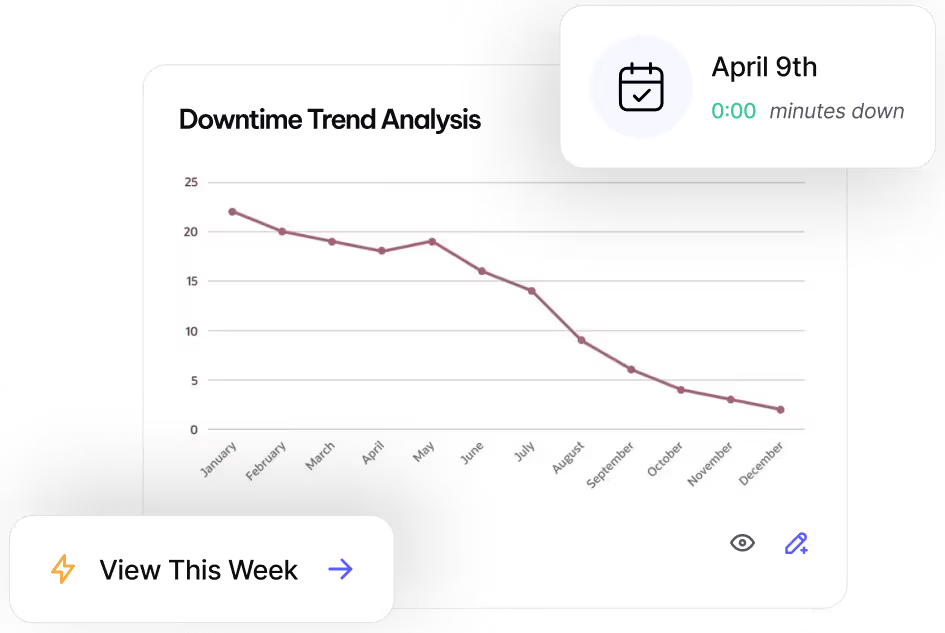
- Downtime events
- Maintenance costs
- Equipment history
Over time, this information provides maintenance leaders with a clear picture of program effectiveness.
Maintenance managers can use these insights to identify assets that require frequent repairs, evaluate preventive maintenance compliance rates, and determine whether maintenance resources are being deployed efficiently. Data-driven decision-making allows organizations to refine maintenance schedules and allocate resources where they create the greatest operational value.
Scalable preventive maintenance programs also play an important role in controlling costs during organizational growth. As facilities expand, labor shortages persist, and capital budgets face increased scrutiny, organizations must maximize the value of existing assets. A CMMS helps accomplish this objective by ensuring maintenance activities are targeted, measurable, and aligned with business goals.
CMMS also helps create the digital infrastructure needed to support future maintenance strategies. Organizations increasingly are adopting mobile maintenance tools, predictive maintenance programs, condition monitoring technologies, and IIoT integrations. A strong preventive maintenance foundation makes these advanced initiatives easier to implement because accurate asset data and standardized workflows already exist within the system.
The result is a maintenance organization that can adapt to changing operational demands without sacrificing consistency or reliability.
Building a scalable preventive maintenance program requires more than creating maintenance schedules. It requires a structured approach that combines standardized processes and actionable performance data. CMMS software serves as the operational backbone that brings these elements together.
As organizations continue to expand operations and face rising performance expectations, scalable preventive maintenance is becoming a business necessity. A modern CMMS provides the framework needed to build that capability and sustain it over the long term.
Learn how MVP One helps preventive maintenance operations.