
Building a predictive maintenance strategy with a CMMS has become a key priority for organizations seeking resilience and operational efficiency.
As asset complexity grows and unplanned downtime grows more expensive, technology leaders, maintenance professionals, and executives are aligning around data-driven maintenance models that deliver measurable business outcomes that show measurable return on investment (ROI) across industrial operations.
Predictive maintenance uses condition data, advanced analytics, and machine insights to anticipate failures before they occur. A CMMS serves as the operational backbone for predictive maintenance. It can centralize asset data, automate workflows, and translate predictive insights into actionable work orders. When combined, these capabilities allow organizations to achieve performance-based best practices.
In an organization, a CMMS-enabled predictive maintenance strategy provides benefits such as:
- For maintenance teams, it reduces guesswork and improves execution through better data insights.
- For reliability professionals, it provides the data foundation needed to analyze failure modes and optimize asset performance.
- For executives, it connects maintenance activities to the organization’s financial performance and long-term planning.
Driving Maintenance Efficiency Through Data, Automation
A CMMS improves predictive maintenance by consolidating asset histories, sensor data, and maintenance records into a single system of record. This approach lets maintenance teams monitor asset condition in real time and trigger work orders based on predictive alerts rather than fixed schedules.
Work orders generated from predictive insights are prioritized based on asset criticality and business impact. This structured approach ensures that resources are properly allocated, which minimizes unplanned downtime across production lines.
Scheduling also becomes more precise. Instead of relying on scheduled maintenance, teams can align their service activities with the equipment condition. This leads to fewer unnecessary interventions and reduces wear caused by over-maintenance. Labor productivity improves because technicians spend more time on high-value tasks and less time responding to unexpected breakdowns.
Reliability experts gain deeper visibility into asset performance trends. A CMMS captures different data streams and creates feedback loops that improve predictive models. Over time, organizations can adjust maintenance triggers and improve asset lifespan by turning the data into actionable information patterns.
This approach also supports compliance and documentation requirements. Maintenance records are automatically logged and accessible for audits. This reduces risk while ensuring adherence to regulatory standards.
Enabling Long-Term Strategic Decisions
For reliability professionals and executives, the strategic value of a CMMS-enabled predictive maintenance extends beyond operational efficiency. It delivers actionable insights that connect maintenance performance to broader business objectives. Executives gain real-time visibility from KPIs including:
- Mean time between failure (MTBF)
- Mean time to repair (MTTR)
- Overall equipment effectiveness (OEE).
These metrics provide a clear view of asset health and operational risk, enabling informed decisions about resource allocation and production planning.
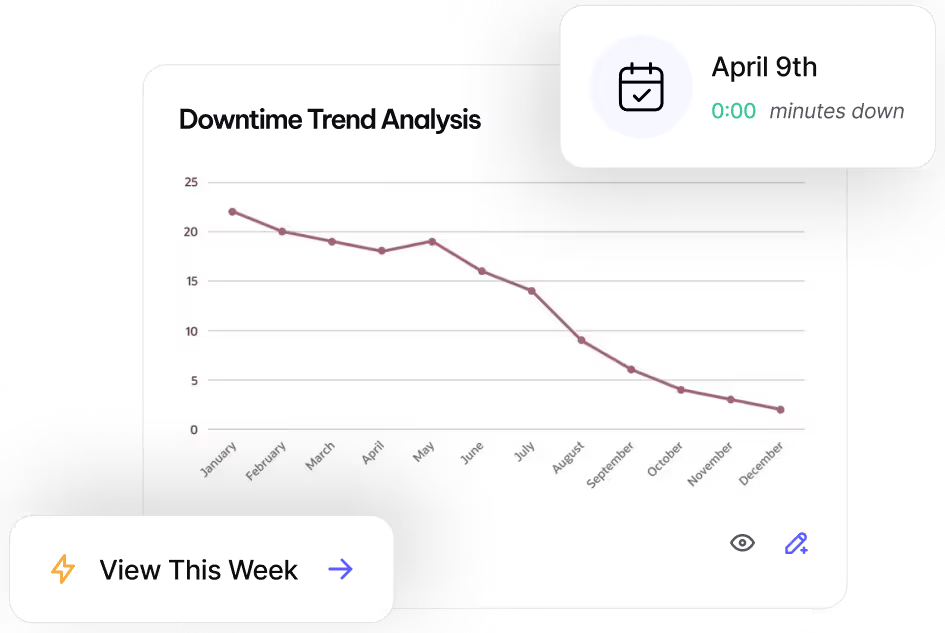
Predictive maintenance reduces unplanned downtime, which is one of the most significant hidden costs in asset-intensive industries. Addressing issues before they lead to failure helps organizations avoid expensive equipment and production losses.
Reliability leaders benefit from advanced analytics capabilities embedded within modern CMMS platforms. Data visualization tools and reporting dashboards make it easier to identify patterns, benchmark performance, and implement continuous improvement initiatives. This analytical foundation supports strategies such as reliability-centered maintenance and asset lifecycle management.
A CMMS also helps standardize processes and build institutional knowledge. Maintenance procedures, inspection routines, and repair histories are documented and shared across teams, reducing dependency on individual expertise. This is particularly valuable in environments facing workforce shortages or high turnover.
Cybersecurity and integration also play a growing role. Modern CMMS platforms integrate with ERP software and IIoT platforms, which links predictive insights with production schedules, supply chain considerations, and financial systems. Technology executives can leverage this integration to create a digital ecosystem that provides a clear and aligned picture from the C-suite to the production floor.
In the end, a predictive maintenance strategy supported by a CMMS equips organizations with the tools needed to transition to proactive asset management.
As industrial environments become more complex, integrating predictive maintenance and CMMS technology can help make operations more sustainable and effective.



Frequently Asked Questions
Lorem ipsum dolor sit amet, consectetur adipiscing elit?

Integer eget ligula velit. Fusce nec varius ligula, ut finibus lorem. Nunc et urna ut augue tristique sagittis fringilla eu dolor. Nam ut pellentesque nibh. Donec maximus massa sit amet dapibus porttitor. Etiam nec ullamcorper ipsum, eu eleifend est. Curabitur pharetra ante turpis, eget convallis neque ultricies et.
Pellentesque auctor vitae est ac interdum?
In porttitor at ligula eu molestie. Pellentesque id consectetur ex, in condimentum lacus. Sed ultricies mi at libero dapibus facilisis. Vestibulum eu rhoncus elit. Fusce sodales rutrum purus quis iaculis. Praesent hendrerit ullamcorper mi id feugiat. Praesent tempor efficitur lacus. Nulla facilisi. Etiam euismod pretium ultricies. Integer iaculis posuere lacus vel gravida. Duis iaculis ullamcorper est eget molestie. Integer vestibulum in magna sit amet volutpat. Nunc maximus nisi nunc, non varius turpis tempus et. Cras at gravida est.